
Kiyosu-Bridge
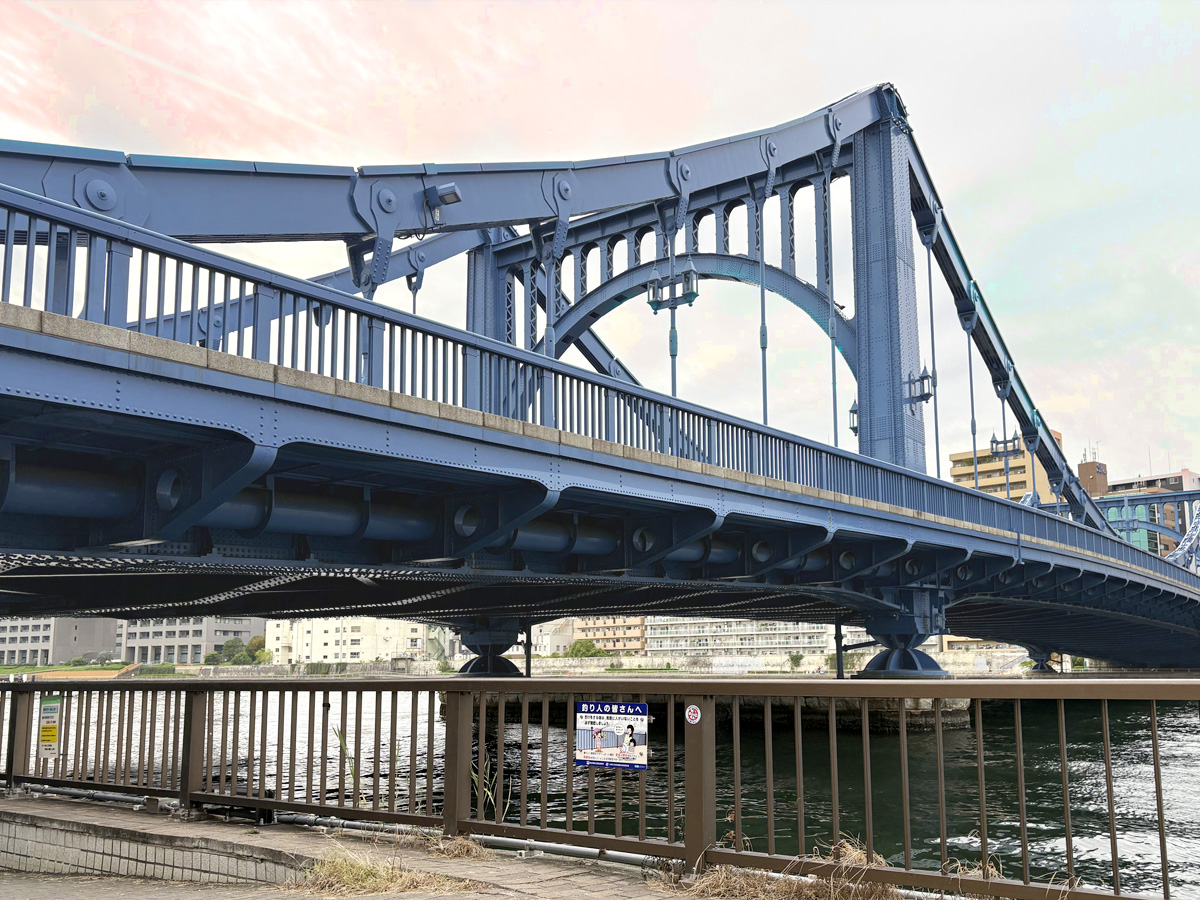
A self-anchored steel suspension bridge Kiyosu-bridge was built over the Sumida River. Designated as an Important Cultural Property of Japan, the bridge was newly constructed in 1928 as part of the reconstruction project following the Great Kanto Earthquake of 1923. It was named Kiyosu Bridge by combining one character each from the western end in Nakasu Town, Nihonbashi, and the eastern end in Kiyosumi Town, Fukagawa.
The unique, graceful curves of Kiyosu Bridge were designed with a delicate, feminine aesthetic, inspired by the Hindenburg Bridge, a suspension bridge over the Rhine River in Cologne, Germany. The area around Nihonbashi Nakasu, where the bridge spans, was famous during the Edo period as a scenic spot for moon viewing and enjoying.
A promenade called the "Sumida River Terrace" has been developed along the Sumida River, making it an ideal place to enjoy the stunning scenery at dusk. It also serves as a relaxing spot for local residents who enjoy jogging, strolling, and unwinding.
Near Kiyosumi-Shirakawa Station, a coffee boom was sparked by the opening of Japan’s first branch of a renowned California-based café. This led to an influx of stylish cafés, transforming the area into a hub for coffee culture.
The unique, graceful curves of Kiyosu Bridge were designed with a delicate, feminine aesthetic, inspired by the Hindenburg Bridge, a suspension bridge over the Rhine River in Cologne, Germany. The area around Nihonbashi Nakasu, where the bridge spans, was famous during the Edo period as a scenic spot for moon viewing and enjoying.
A promenade called the "Sumida River Terrace" has been developed along the Sumida River, making it an ideal place to enjoy the stunning scenery at dusk. It also serves as a relaxing spot for local residents who enjoy jogging, strolling, and unwinding.
Near Kiyosumi-Shirakawa Station, a coffee boom was sparked by the opening of Japan’s first branch of a renowned California-based café. This led to an influx of stylish cafés, transforming the area into a hub for coffee culture.



INFORMATION

1-1 Kiyosumi, Koto-ku, Tokyo
①about 14 minutes walk from Exit B1 of Kiyosumi-shirakawa Station on the Tokyo Metro Hanzoumon Line
②about 13 minutes walk from Exit A1 of Kiyosumi-shirakawa Station on the Tokyo Metro Oedo Line
